

Step-by-Step: Walking for Parkinson’s disease

Parkinson’s disease is a nervous system disorder that’s increasingly contributing to death and disability across the globe (1;2). When someone brings up Parkinson’s disease, many of us automatically think of tremors. This isn’t surprising given that, over the years, this characteristic has been the focus of public educational campaigns and depictions of the disease within media. But, when we look beyond tremors to get a fuller picture of this disease and its effects on daily life and functioning, we see that it’s characterized by a range of motor and non-motor symptoms (1;2). These include slow movements, muscle stiffness, poor balance, trouble walking, pain, sensory issues (e.g., loss of smell), difficulty sleeping, and impaired cognition
(1).
People living with Parkinson’s disease have provided key insights into their experiences and priorities. For example, of the disease’s far-reaching symptoms, trouble walking is one of their top concerns. As a result, effectively addressing this challenge may have a significant impact on their daily lives (1;3;4). This priority has gone on to guide and inform research (1).
With this in mind, let’s turn our attention to a recent systematic review
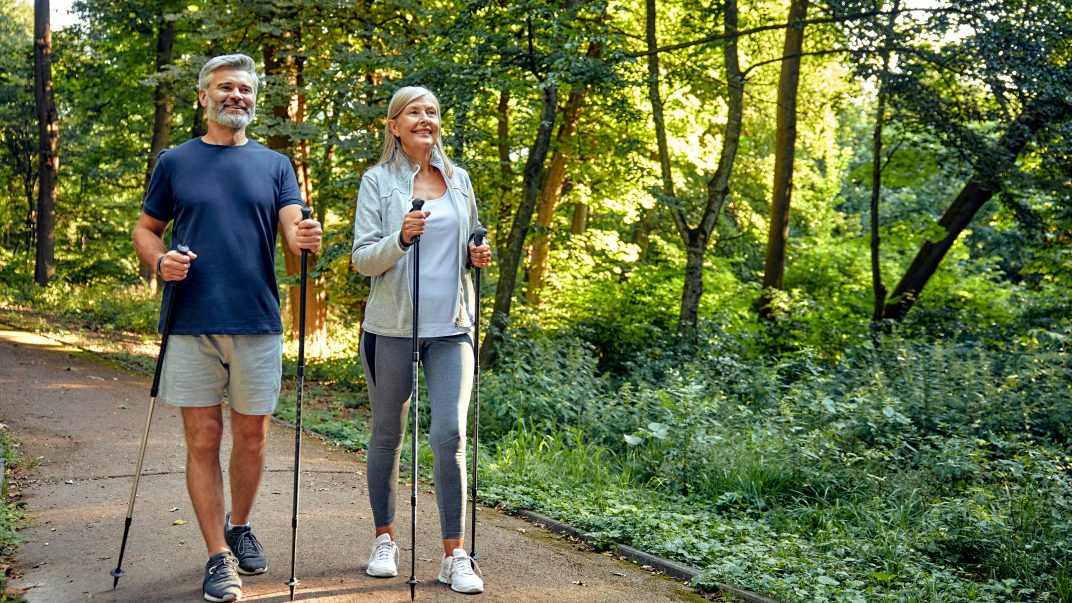
that looks at the effects of voluntary structured walking programs on different elements of walking ability in people living with Parkinson’s disease. Here, “voluntary” simply means walking independently, walking with certain aids like canes, harnesses, ski poles used in Nordic walking, or walking on a treadmill. Additionally, “structured” refers to organized or planned walking programs with specific walking frequencies, durations, and intensities (1).
So, does “walking the walk” help?
What the research tells us
Ready, set, walk! The review found that voluntary structured walking programs can meaningfully improve walking speed, step length, and stride length in people living with Parkinson’s disease. Walking distance, disease severity, and mobility may also improve but the evidence on whether these changes are large enough to make a meaningful difference in daily life is not as clear. These positive results may be most applicable to people with earlier-stage Parkinson’s disease or less severe disability. Since the review looked at studies that required participants to be able to walk on their own or have some degree of walking function, we can’t overgeneralize the findings.
Where are we less optimistic or unable to make a comment? Well, cadence (the number of steps taken per minute) did not improve, and unfortunately there isn’t enough evidence to assess the effects on overall quality of life. More research is also needed to provide a better understanding of whether these benefits hold up in the long term and the most effective walking program or routine (1).
In the meantime, we can look for ways to make walking more regularly a habit. Starting small and building up to walking longer or more frequently keeps things manageable. Finding a form of walking that we enjoy and aligns with our abilities can also motivate us to lace up our runners and stick with it. Luckily, walking is an activity with endless possibilities! We can walk indoors or outdoors, in the comfort of our homes or at the gym, with or without a treadmill, and solo or with the company of friends, family, or peers. But safety should always be the number one priority, especially when there are underlying health issues that impact balance, movement, and cognition. Consulting our healthcare team is helpful in identifying how best to safely and successfully engage in walking as a form of exercise based on our individual needs.
References
- World Health Organization. Parkinson disease. [Internet] 2023. [cited August 2026]. Available form: https://www.who.int/news-room/fact-sheets/detail/parkinson-disease
- Kloster CT, Bonde-Jensen F, Langeskov-Christensen M, et al. Parkinson’s disease and voluntary walking interventions – A systematic review and meta-analysis. Arch Phys Med Rehabil. 2026; 107(6):1439-1452. doi: 10.1016/j.apmr.2026.01.024.
- Uebelacker LA, Epstein-Lubow G, Lewis T, et al. A survey of Parkinson’s disease patients: Most bothersome symptoms and coping preferences. J Parkinsons Dis. 2014; 4:717–23.
- Port RJ, Rumsby M, Brown G, et al. People with Parkinson’s disease: What symptoms do they most want to improve and how does this change with disease duration? J Parkinsons Dis. 2021; 11:715–24.
McMaster Optimal Aging Blog Posts are written by faculty, staff, PhD students, and external collaborators, and are assessed for accuracy by members of the Portal scientific leadership team.
DISCLAIMER: These summaries are provided for informational purposes only. They are not a substitute for advice from your own health care professional. The summaries may be reproduced for not-for-profit educational purposes only. Any other uses must be approved by the McMaster Optimal Aging Portal (info@mcmasteroptimalaging.org).