

Exercise following menopause: What works for bone health?
More than 2.3 million Canadians live with osteoporosis, a condition that causes bones to become weak and break more easily. If we dig deeper into the stats, we see that over 80% of all broken bones in people aged 50 and over are due to osteoporosis, often referred to as a ‘silent thief’ or ‘silent disease’ because of its lack of symptoms. While anyone at any age can develop this condition, women are at a higher risk. It’s estimated that women make up approximately 80% of people who live with an osteoporosis diagnosis, and that at least 1 in 3 will break a bone because of it (1).
Women who’ve gone through menopause, also known as postmenopausal women, are especially at risk of developing osteoporosis (1;2). This is because they experience a major fall in their estrogen levels (2;3). While many of us know estrogen as an important sex hormone, we don’t often talk about the role it plays in preserving the health of our bones (2;4). So, what does estrogen do for our bones? Estrogen helps maintain the delicate balance between the breakdown of old bone and the formation of new bone. When estrogen levels drop, this balance is disturbed, causing bone loss to speed up and bone density to decrease (2;5;6).
The question then becomes: what can women who’ve gone through menopause do to promote the health of their bones? You may have guessed this was coming…but exercise is one strategy! What kinds of exercise are effective? Let’s answer this question with the help of a recent systematic review that looked at a range of exercise types (2).
What the research tells us
Overall, the review found that several exercise types, alone and in combination, can help improve bone density in women who’ve gone through menopause. The areas of the body that see bone density benefits vary depending on exercise type.
In terms of standalone exercises, here’s what can work and where:
- Mind-body exercise, which includes activities like tai chi, yoga, and Pilates, can improve bone density in the lower spine, parts of the hip, and at the top of the thigh bone near the hip.
- Aerobic exercise, which includes activities like walking and cycling, can improve bone density at the top of the thigh bone near the hip.
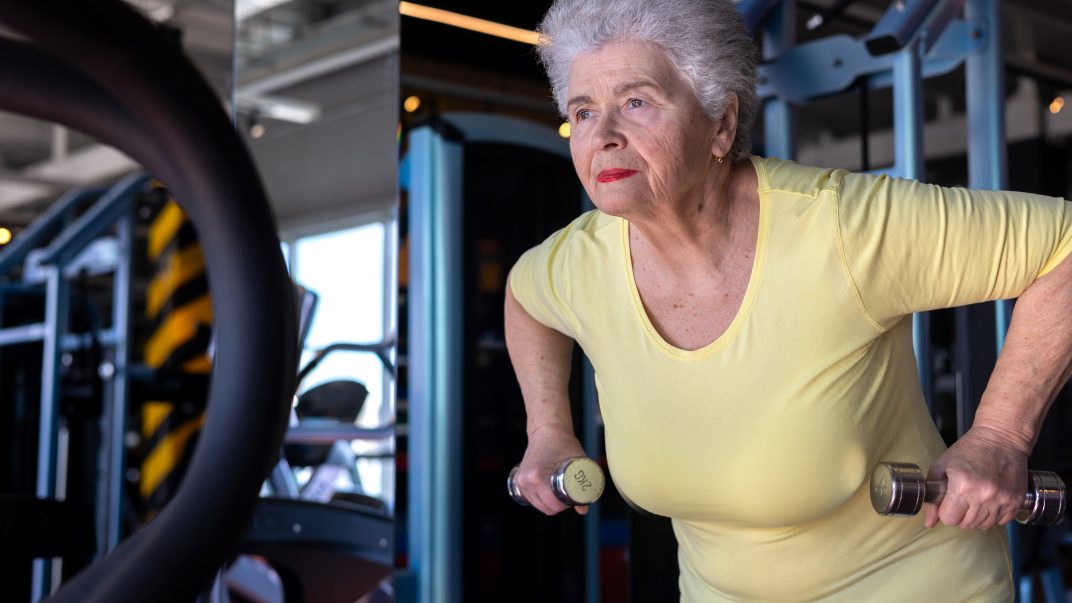
- Resistance or strength exercise, which includes activities like weight training and elastic band training, can improve bone density in the lower spine, at the top of the thigh bone near the hip, and in the hip overall.
- Impact exercise, which includes activities like skipping rope, jumping and weighted jogging, can improve bone density in the hip overall.
While exercises done alone can be effective, certain exercise combinations may provide greater benefits. For instance, engaging in mind-body exercise together with resistance exercise appears to be one of the most effective strategies for improving bone density in areas like the lower spine, parts of the hip, at the top of the thigh bone near the hip, and throughout the entire body. What’s more, aerobic exercise done alongside resistance exercise, as well as exercise programs that feature three or more exercise types, can improve bone density in the hip overall. Sticking with an exercise program or routine for at least one year appears to be important for seeing consistent improvements in bone density. And in even more positive news, women with and without osteoporosis can see similar benefits.
Whether you have osteoporosis or would like to help prevent it, exercise can be an important part of your prevention and treatment plans. Work with your healthcare team to create a personalized plan that takes into consideration your exercise preferences, areas of concern, what type of exercise program best suits your health status and abilities, and how to move safely (2).
References
- Osteoporosis Canada. Facts & stats. [Internet] 2022. [cited June 2026]. Available from: https://osteoporosis.ca/facts-and-stats/
- Zhou Z, Wei X, Zhang X, et al. Effects of different types of exercise over 24 weeks on bone mineral density in postmenopausal women: A systematic review with pairwise and network meta-analysis of randomized controlled trials. J Sport Health Sci. 2026; 15:101127. doi: 10.1016/j.jshs.2026.101127.
- Greendale GA, Sowers M, Han W, et al. Bone mineral density loss in relation to the final menstrual period in a multiethnic cohort: Results from the study of women’s health across the nation (SWAN). J Bone Miner Res. 2012; 27:111–8.
- Cauley JA. Estrogen and bone health in men and women. Steroids. 2015; 99:11–5.
- Khosla S, Oursler MJ, Monroe DG. Estrogen and the skeleton. Trends Endocrinol Metab. 2012; 23:576–81.
- Streicher C, Heyny A, Andrukhova O, et al. Estrogen regulates bone turnover by targeting RANKL expression in bone lining cells. Sci Rep. 2017; 7:6460. doi:10.1038/s41598-017-06614-0.
McMaster Optimal Aging Blog Posts are written by faculty, staff, PhD students, and external collaborators, and are assessed for accuracy by members of the Portal scientific leadership team.
DISCLAIMER: These summaries are provided for informational purposes only. They are not a substitute for advice from your own health care professional. The summaries may be reproduced for not-for-profit educational purposes only. Any other uses must be approved by the McMaster Optimal Aging Portal (info@mcmasteroptimalaging.org).