

3 ways to support safer driving as we age

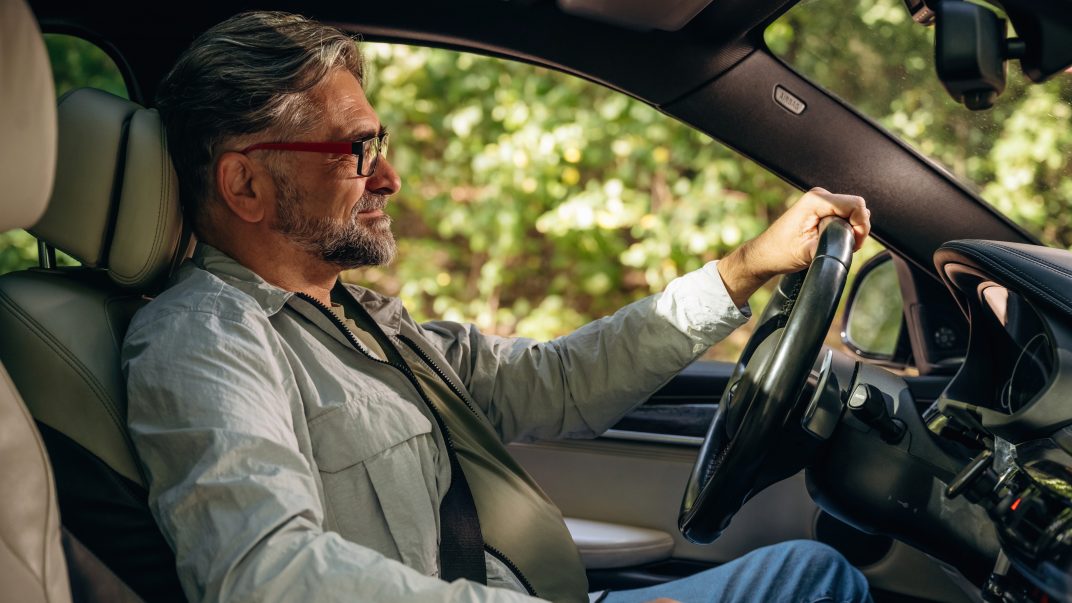
In 2022, there were around 28 million licensed drivers in Canada. It’s no surprise, then, that one of the most common ways to travel within and between Canadian cities is by car (1). That said, driving isn’t just a way to get from Point A to Point B. For many of us, it’s also a symbol of independence, freedom, and having control over our own lives.
Driving is a complex activity that requires the coordination of our senses, motor functions, and cognitive functions, as well as the ability to multitask (2-4). It’s a difficult task whether you’re 20 or 60! And while it’s not a driver’s age that determines their ability to drive, some of the skills and functions we rely on to drive safely can change as we grow older (5). So, what are a few things we can do to support ourselves in staying safe and confident behind the wheel for as long as possible? Let’s talk about protecting our senses, driver training, and smart technologies (6-9).
Click on the links below to learn more.
1. Protecting our senses
Sensory loss, such as declines in vision and hearing, can increase the risk of driving collisions (10-12). For example, changes in vision and hearing can make it harder to detect contrast and movement, or notice approaching vehicles and obstacles (13;14). But there are things we can do to help protect and improve our sensory health. These include wearing ear protection and sunglasses when needed, having our vision and hearing checked regularly to identify and address problems, and incorporating assistive technologies like prescription lenses and hearing aids (6).
2. Participating in driver training
Training programs for older drivers appear to improve driving skills, especially on-road programs. Three may be the magic number, with programs lasting at least three weeks and providing three or more hours of training spread across at least three sessions appearing to work best (9). Additional research shows that classroom instruction alone or in combination with on-road feedback and tailored training can enhance knowledge of road safety, while discussions with our healthcare team can help us adjust our driving practices (8). Some evidence suggests that driver training may decrease car crashes in older adults, although this finding was only based on two studies (9).
3. Incorporating smart technologies
In-vehicle technologies that aim to make driving easier and safer are increasingly available. These include in-vehicle information systems, such as intersection warning systems and lane change or lane departure warning systems, as well as advanced driver assistance systems, such as adaptive cruise control and assisted parallel parking. Some smart, in-vehicle technologies can improve the safety and comfort of older drivers, so long as they match the driver’s abilities and don’t become distracting or too mentally demanding to use (7). Occupational therapists can make recommendations on how older adults can best adapt their vehicles to meet their needs and provide training on how to use new technologies (15).
Staying safe and confident behind the wheel is a priority for drivers of all ages. Protecting our vision and hearing, participating in driver training, and adapting our vehicles with smart technologies that match our needs can help support safer driving. Luckily, we don’t have to travel this road alone! Healthcare professionals can assess how our health may affect our driving, help us identify our driving-related needs, and make recommendations on useful strategies to adopt.
References
- Government of Canada. Evaluation of road safety programs. [Internet] 2025. [cited June 2026]. Available from: https://tc.canada.ca/en/corporate-services/transparency/corporate-management-reporting/evaluation-reports/evaluation-road-safety-programs
- Andersen GJ. Aging and vision: Changes in function and performance from optics to perception. Wiley Interdiscip Rev Cogn Sci. 2012; 3(3):403-10. doi: 10.1002/wcs.1167.
- Campos J, Ramkhalawansingh R, Pichora-Fuller MK. Hearing, self-motion perception, mobility, and aging. Hear Res. 2018; 369:42-55. doi: 10.1016/j.heares.2018.03.025.
- Campos JL, Marusic U, Mahoney JR. The intersection of cognitive, motor, and sensory processing in aging: Links to functional outcomes, Volume I. Front Aging Neurosci. 2022; 14:1-4. doi: 10.3389/fnagi.2022.1009532.
- McMaster Optimal Aging Portal. How do we know when it’s time for someone to hang up the car keys? 12 February 2018.
- World Health Organization. Integrated care for older people (ICOPE): Guidance for person-centred assessment and pathways in primary care. [Internet] 2019. [cited June 2026]. Available from: https://iris.who.int/items/061e2e71-1dc9-4ae7-acb8-25e710a87299
- Classen S, Jeghers M, Morgan-Daniel J, et al. Smart in-vehicle technologies and older drivers: A scoping review. OTJR. 2019; 39(2):97-107.
- Sangrar R, Mun J, Cammarata M, et al. Older driver training programs: A systematic review of evidence aimed at improving behind-the-wheel performance. J Safety Res. 2019; 71:295-313.
- Ishii H, Okubo Y, Doi T, et al. Effect of driving training on car crashes and driving skills in older people: A systematic review and meta-analysis. Geriatr Gerontol Int. 2023; 11: 771-778.
- Freeman EE, Munoz B, Turano KA, et al. Measures of visual function and time to driving cessation in older adults. Opt Vis Sci. 2005; 82(8):765-773. doi: 10.1097/01.opx.0000175008.88427.05.
- Owsley C, Wood JM, McGwin Jr G. A roadmap for interpreting the literature on vision and driving. Surv Ophthalmol. 2015; 60(3):250-262. doi: 10.1016/j.survophthal.2015.01.005.
- Green KA, McGwin Jr G, Owsley C. Associations between visual, hearing, and dual sensory impairments and history of motor vehicle collision involvement of older drivers. J Am Geriatr Soc. 2013; 6:252-257. doi: 10.1111/jgs.12091.
- Andersen GJ. Aging and vision: Changes in function and performance from optics to perception. Wiley Interdiscip Rev Cogn Sci. 2012; 3:403-10. doi: 10.1002/wcs.1167.
- Campos J, Ramkhalawansingh R, Pichora-Fuller MK. Hearing, self-motion perception, mobility, and aging. Hear Res. 2018; 369:42-55. doi: 10.1016/j.heares.2018.03.025.
- Government of Québec. Senior drivers – Did you know? [Internet] 2024. [cited June 2026]. Available from: https://saaq.gouv.qc.ca/en/road-safety/client-groups/seniors/did-you-know
McMaster Optimal Aging Blog Posts are written by faculty, staff, PhD students, and external collaborators, and are assessed for accuracy by members of the Portal scientific leadership team.
DISCLAIMER: These summaries are provided for informational purposes only. They are not a substitute for advice from your own health care professional. The summaries may be reproduced for not-for-profit educational purposes only. Any other uses must be approved by the McMaster Optimal Aging Portal (info@mcmasteroptimalaging.org).