
3 tips to support brain health
Over the past 10 years, we’ve seen an increased focus on the concept of “brain health” (1). A snapshot of statistics from the United States highlights how maintaining and improving brain health is something that many adults are actively thinking about. In fact, over 84% of adults consider brain health to be “very important” (2). When we zoom in on why, we find that 77% of older adults expect themselves to experience cognitive decline, while 50% foresee dementia in their future (3).
The question then becomes: what can we actually do to support our brain health? One answer is to seek out and apply research-backed strategies. Things like sitting less, moving more, sleeping well, eating a well-balanced diet, quitting smoking, drinking less alcohol, managing high blood pressure, diabetes, cholesterol, and our weight, stimulating our brain, staying social, and minding the health of our ears and eyes immediately come to mind (4). Today, let’s look at three specific strategies related to a few of these options.
1. Tap into your musical side
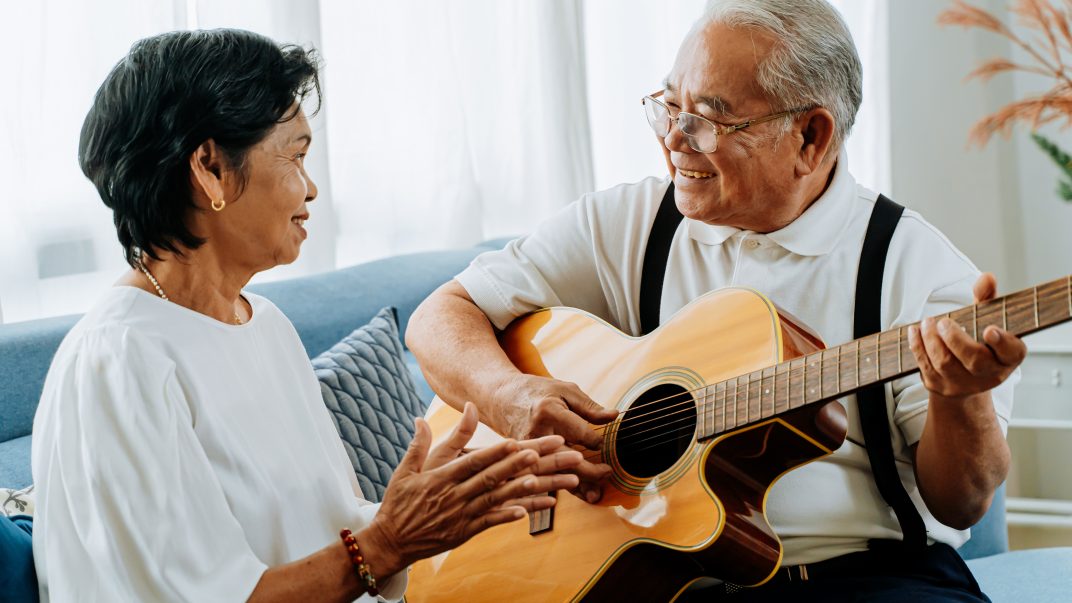
Cognitive function refers to the mental processes and skills that help us understand and use information in our daily lives. These include things like thinking, learning, remembering, and making decisions. Preliminary research shows that in older adults with cognitive impairment or mild to moderate dementia, participating in professionally delivered active music-making therapy may produce small but helpful improvements in cognitive functioning. Here, “active” refers to being involved in the music-making process, as opposed to simply listening to music for relaxation. And contrary to popular belief, we don’t have to be famous rock stars or classically-trained violinists to participate. Activities like clapping, singing, and playing an instrument can all be part of professionally delivered music-making programs (5).
2. Engage in aerobic exercise
Executive function is an example of a cognitive function. It includes processes and skills like problem solving, temporarily holding onto information and using it during an activity (also known as working memory), organizing and planning, adjusting to change (also known as cognitive flexibility), and impulse control (6-8). Research shows that in healthy middle-aged adults and older adults, engaging in aerobic exercise can improve different elements of executive function—specifically working memory, cognitive flexibility, and impulse control. Activities like hiking, cycling, swimming, dancing, and walking are examples of aerobic exercises. What’s more, the type, intensity, duration, and frequency of aerobic exercise may matter, with different approaches appearing to benefit different aspects of executive function (6).
3. Protect your senses
Research shows a link between sensory loss, such as vision and hearing loss, and cognitive health (9-11). One possible explanation is that sensory impairments can make it harder to stay physically and socially active (12-14). Reduced physical activity and social isolation are, in turn, associated with an increased risk of cognitive decline and dementia (15;16). Additionally, reduced vision and hearing may make it harder for the brain to understand and remember information. In the long term, this may affect brain structure and how the brain uses information. (17). Avoiding excessive noise and getting our hearing and vision checked regularly to identify and address any issues using tools like prescription lenses, hearing aids, and cataract surgery are a few ways we can protect our senses and support our brain health (4).
Being proactive about our brain health is important. Luckily, there are many strategies we can implement within our daily lives. Not sure where to start making lifestyle changes or which strategy to implement first? You can always start with one and work your way up to integrating more. Don’t forget, your healthcare team can help you learn more about your options and develop a tailored plan that works for you.
References
-
- Mehegan L. Most older adults are familiar with brain health but are divided on ways to lower dementia risk. [Internet] 2025. [cited July 2026]. Available from: https://www.aarp.org/pri/topics/health/brain-health/brain-health-awareness/
- AARP Research. AARP research insights on brain health. [Internet] 2026. [cited July 2026]. Available from: https://www.aarp.org/pri/topics/health/brain-health/aarp-research-insights-brain-health/
- Mehegan L. What adults think and do about brain health. [Internet] 2025. [cited July 2026]. Available from: https://www.aarp.org/pri/topics/health/brain-health/brain-health-behaviors-outcomes/
- Levinson AJ, Sztramko R. How to promote brain health. McMaster Optimal Aging Portal. Published February 19, 2023. Accessed July 2, 2026. https://www.mcmasteroptimalaging.org/e-learning/how-to-promote-brain-health
- Dorris JL, Neely S, Terhorst L, et al. Effects of music participation for mild cognitive impairment and dementia: A systematic review and meta-analysis. J Am Geriatr Soc. 2021; 69(9):2659-2667. doi: 10.1111/jgs.17208.
- Ye M, Song T, Xia H, et al. Effects of aerobic exercise on executive function of healthy middle-aged and older adults: A systematic review and meta-analysis. Int J Nurs Stud. 2024; 160:104912. doi: 10.1016/j.ijnurstu.2024.104912.
- Tian S, Liang Z, Qiu F, et al. Physical activity on executive function in sedentary individuals: Systematic review and meta-analysis of randomized controlled trials. PLoS One. 2023; 18(12):e0294251.
- Xiong J, Ye M, Wang L, et al. Effects of physical exercise on executive function in cognitively healthy older adults: A systematic review and meta-analysis of randomized controlled trials: Physical exercise for executive function. Int J Nurs Stud. 2021; 114:103810. doi: 10.1016/j.ijnurstu.2020.103810.
- Lin FR, Yaffe K, Xia J, et al. Hearing loss and cognitive decline in older adults. JAMA Intern Medi. 2013; 173(4): 293-299. doi: 10.1001/jamainternmed.2013.1868.
- Loughrey DG, Kelly ME, Kelley GA, et al. Association of age-related hearing loss with cognitive function, cognitive impairment, and dementia: A systematic review and meta-analysis. JAMA Otolaryngol Head Neck Surg. 2018; 144(2):115-126. doi: 10.1001/jamaoto.2017.2513.
- Ehrlich, JR, Goldstein J, Swenor B, et al. Addition of vision impairment to a life-course model of potentially modifiable dementia risk factors in the US. JAMA Neurol. 2022; 79(6):623-626. doi: 10.1001/jamaneurol.2022.0723.
- Assi S, Twardzik E, Deal JA, et al. Hearing loss and physical activity among older adults in the United States. J Gerontol A Biol Sci Med Sci. 2024; 79(1):glad186. doi: 10.1093/gerona/glad186.
- Ong SR, Crowston JG, Loprinzi PD, et al. Physical activity, visual impairment, and eye disease. Eye. 2018; 32(8): 1296-1303. doi: 10.1038/s41433-018-0081-8.
- Mick P, Parfyonov M, Wittich W, et al. Associations between sensory loss and social networks, participation, support, and loneliness: Analysis of the Canadian Longitudinal Study on Aging. Can Fam Physician. 2018; 64(1):e33-41.
- Evans IE, Martyr A, Collins R, et al. Social isolation and cognitive function in later life: A systematic review and meta-analysis. J Alzheimers Dis. 2019 70(s1):S119-44. doi: 10.3233/JAD-180501.
- Blondell SJ, Hammersley-Mather R, Veerman JL. Does physical activity prevent cognitive decline and dementia?: A systematic review and meta-analysis of longitudinal studies. BMC Public Health. 2014; 14:1-2. doi: 10.1186/1471-2458-14-510.
17. Uchida Y, Sugiura S. Nishita Y, et al. Age-related hearing loss and cognitive decline—The potential mechanisms linking the two. Auris Nasus Larynx. 2019; 46(1):1-9. doi: 10.1016/j.anl.2018.08.010.
McMaster Optimal Aging Blog Posts are written by faculty, staff, PhD students, and external collaborators, and are assessed for accuracy by members of the Portal scientific leadership team.
DISCLAIMER: These summaries are provided for informational purposes only. They are not a substitute for advice from your own health care professional. The summaries may be reproduced for not-for-profit educational purposes only. Any other uses must be approved by the McMaster Optimal Aging Portal (info@mcmasteroptimalaging.org).